Why Range of Motion Is the Foundation of Long-Term Movement Health
Welcome to The RANGE
A Chiropractic, Rehabilitation, and Movement Health Practice Built for Long-Term Capacity
At The RANGE, we provide chiropractic care, rehabilitation, and movement-focused healthcare with a singular goal: helping people restore and expand their capacity to move well for life.
Our approach is grounded in empathy, education, and individualized care. We don’t chase symptoms or rely on one-size-fits-all solutions. Instead, we help patients understand why their body feels restricted, how it adapted to stress or injury, and what is required to rebuild resilience over time.
This page exists to explain why joint range of motion and movement capacity, not age or fitness level, are the primary drivers of long-term physical health, resilience, and pain-free movement.
This is not about quick fixes.
It’s about restoring options.
What Does “The RANGE” Mean?
The name The RANGE reflects a foundational philosophy that guides how we approach movement, rehabilitation, and long-term health.
Governing Principle:
Movement health declines when the body’s ability to access and control joint range of motion falls below the demands of daily life and sport.
Everything that follows is downstream of this rule.
RANGE as a Philosophy: Why Generalists Win Long-Term
In the book Range, David Epstein explains why people with broad skill sets often outperform specialists over the long term. Generalists develop adaptability, creativity, and the ability to solve complex problems by connecting ideas across domains.
The same principle applies to movement and physical health.
If the goal is a long, active life, the body cannot afford to specialize too narrowly. Over-specialization, whether through sport, exercise habits, or lifestyle, shrinks movement options and increases injury risk.
Joint health is the foundation of movement. When joints can move freely and tolerate force through a wide range of motion:
Strength is easier to build
Coordination improves
Injury risk decreases
Recovery improves
A wide movement bandwidth allows the body to distribute stress instead of concentrating it repeatedly in the same tissues.
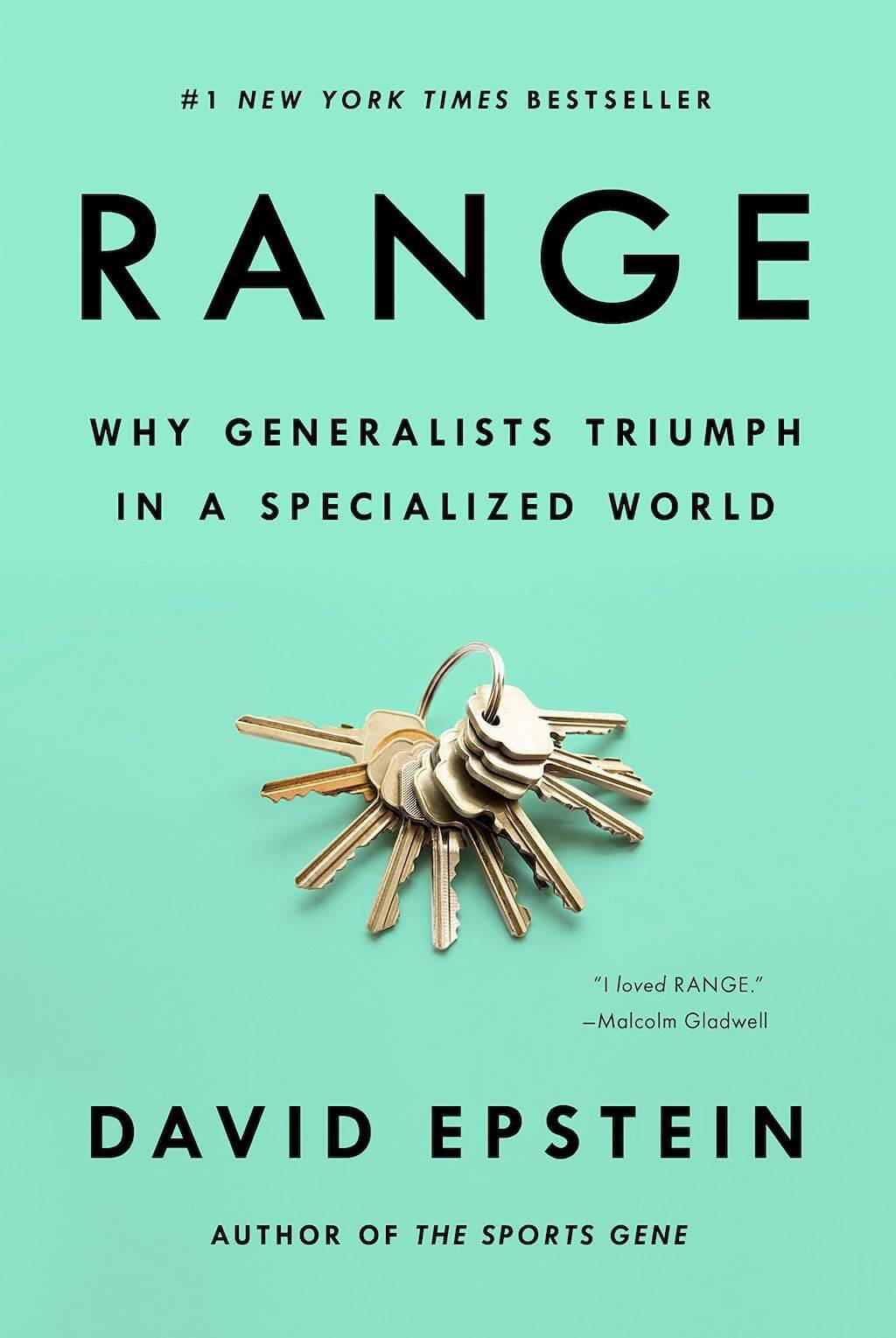
“Breadth of training predicts breadth of transfer. That is, the more contexts in which something is learned, the more the learner creates abstract models, and the less they rely on any particular example. Learners become better at applying their knowledge to a situation they’ve never seen before, which is the essence of creativity.”
David Epstein
The Practice Range: Where Capacity Is Built Safely
In golf, the practice range exists so players can experiment without consequence. It’s a place to test ideas, refine technique, and expand options before stepping onto the course.
Rehabilitation and movement training work the same way.
Healthy movement requires exploration:
Accessing unfamiliar positions
Applying controlled force in new ranges
Gradually expanding what the body can tolerate
Most modern lives are highly repetitive. We sit the same way, move the same way, and avoid positions that feel uncomfortable. Over time, this shrinks the body’s usable movement space.
A structured movement practice restores variability and adaptability, two essential qualities for long-term joint health.

Arizona State University practice facility, Phoenix, AZ

Shoulder Controlled Articular Rotations

Active ROM is movement potential
Range of Motion Is Movement Potential, Not Flexibility
Range of motion is not about being excessively flexible.
It represents movement potential.
When range of motion is limited, the nervous system has fewer options. The body compensates. Compensation itself is not inherently bad, but repeated compensation increases wear, overload, and injury risk over time.
Many people feel “tight” not because they need to stretch, but because they cannot produce force in certain positions. In these cases, targeted strengthening is often more effective, and safer, than passive stretching.
Muscle, tendon, and joint capsule are living, hydrated tissue, and the water inside them isn’t passive filler. At the surface of collagen and every cell membrane it touches, water organizes into a more ordered, charge-carrying state than ordinary water, and that structuring is what lets the tissue move energy through itself efficiently. That structuring isn’t fixed. It depends on the tissue staying metabolically active, on blood flow, cellular energy production, and ongoing use, and it degrades when a joint goes underused or a position gets avoided. A hip that won’t rotate past a certain point, or a shoulder that stalls halfway overhead, can mean the tissue at that joint has lost some of that ordered, energy-conducting state. The nervous system responds the only way it knows how: it keeps you out of the position instead of letting you get hurt in it.
Researcher Martin Picard calls the cellular version of this energy resistance: the harder a cell is asked to work relative to its actual capacity to move energy through it, the more its output stalls. That resistance shows up inside the mitochondria, running on the same underlying principle just described at the collagen surface: structured water enabling or limiting how efficiently charge and energy move through living tissue, here applied at a smaller scale, inside the cell instead of around it. Applied to a joint, the restriction you feel in a position is that resistance showing up as reduced force output right there. That’s why strengthening a position, which actually asks that system to work and rebuild its capacity, can unlock it faster than stretching alone.
True mobility means the ability to:
Control a joint through its range
Accept and produce force there
Access that range confidently when life demands it
Justin Rose discussing the importance of his warmup routine before playing a round of golf.

Function often improves, before pain changes. Over time improved function leads to decreases in pain.
When Movement Health Breaks Down
Pain or stiffness often leads people to restrict movement to pain-free ranges. While temporary modification may be necessary, long-term avoidance reduces overall movement capacity.Over time, people begin removing options from what we call their Movement Menu, the total set of positions, loads, and movements their body can confidently access.As that menu shrinks:Exercise becomes inconsistentFitness progress stallsOrthopedic issues derail momentumMany people trying to “get back in shape” encounter joint or tissue limitations before they see meaningful results. Fitness pursued without regard for tissue capacity often leads to setbacks.Health should not be sacrificed in the pursuit of fitness.This is where structured, active rehabilitation becomes essential, addressing joint-specific limitations rather than simply avoiding pain.
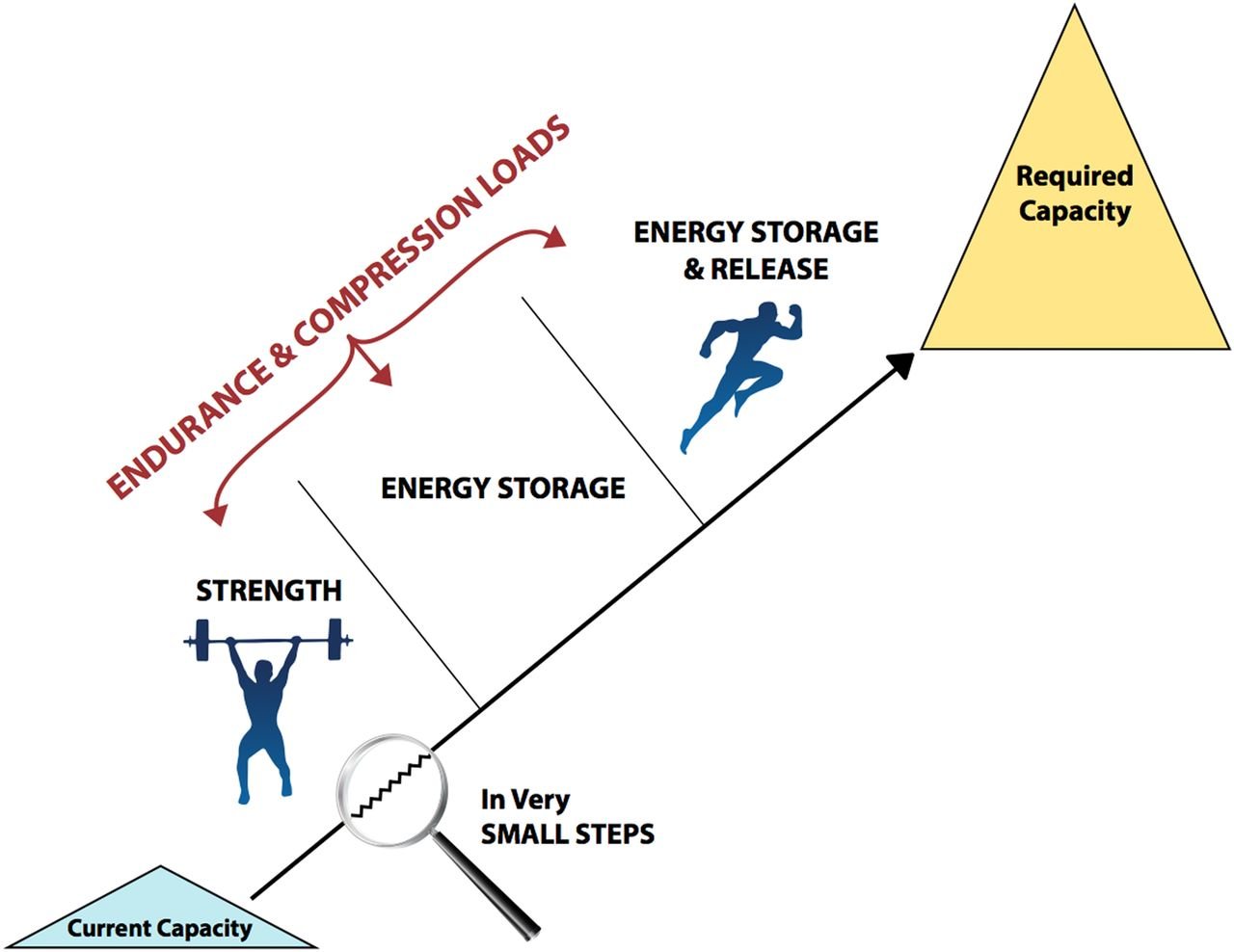
During Tendinopathy rehabilitation we have to use gradual loading over time to create progress.
How the Body Adapts: Frequency, Intensity, and Duration
Injury risk rises sharply when frequency, intensity, and duration increase at the same time. Sustainable progress requires adjusting one variable at a time.
Every increase in frequency, intensity, or duration raises the amount of energy the tissue doing the work has to move through its own water and cells to meet the load. Push demand past what that tissue can currently deliver, and that gap is where breakdown happens. Change one variable at a time, and the tissue has room to rebuild that capacity and meet the new demand.
Different tissues adapt at different rates:
Muscle adapts relatively quickly
Tendons, ligaments, and joint capsules adapt more slowly
Muscle is dense with mitochondria and richly supplied with blood, and both feed the energy that keeps the tissue’s structured, charge-carrying water built up and available under load, the same structuring described earlier that lets tissue move energy through itself efficiently. Tendon, ligament, and joint capsule carry far less of both. Less blood flow and fewer mitochondria on hand mean less energy available to keep rebuilding that structuring once loading disturbs it, and that sets a slower ceiling on how fast that tissue can adapt to new demand, regardless of how motivated the person attached to it is.
Respecting these timelines allows steady progress without unnecessary injury.
Fitness is not a destination.
It is a long-term process of adaptation.

Joint Workspace is like a wide open expanse of land you can go anywhere. You have movement options.
Why Range of Motion Matters for the Nervous System
Every joint sends sensory information to the brain, a process known as afference. Adequate joint range of motion improves the quality and quantity of this feedback.Collagen has a physical property most people have never heard of: bend or compress it, and it generates a small electrical charge on its own. Researcher Robert Becker demonstrated this directly in bone decades ago, and tendon, ligament, and joint capsule are built from the same collagen, so they carry the same property. Collagen is also where the structured water described earlier does its work: the same tissue carries both an ordered, energy-conducting water layer and this piezoelectric charge, and both depend on the tissue actually being used. Moving a joint through more of its available range means more mechanoreceptor firing and more of that electrical signal together, giving the brain a clearer, higher-resolution picture of where the body actually is. A joint that only moves through a narrow slice of what it’s built for is starved of both signals, part of why a restricted joint can start to feel disconnected or foreign even after the pain is gone.Even if a joint does not move much during a specific task, better sensory input improves coordination, confidence, and movement efficiency.When a joint’s usable range, its articular workspace, is limited, movement becomes stiff, awkward, and inefficient. While mobility alone does not guarantee good movement, clean movement is impossible without it.Joint-specific training helps restore both range of motion and the sensory input the nervous system relies on for efficient movement.
Why This Matters for Real Life
Restricted movement often leads to feelings of awkwardness, intimidation, or disconnection from the body. To avoid discomfort, people move less.This creates a negative feedback loop:
Less movement → less capacity → more restriction → even less movement.As the French physician Clement Joseph Tissot wrote:“Movement is expected to take the place of many remedies, but all the remedies together can never take the place of movement.”
Stiff Tin Man or Supple Ninja?
Good mobility allows freedom, resilience, and confidence in daily life.
Poor mobility feels restrictive, fragile, and limiting.Age is not the primary reason people lose movement capacity. Loss of movement reflects:Past injuriesRepetitive habitsLimited exposure to varied positions over timeThe body remains adaptable at every age when given the right inputs.

The Tinman needs oil
Start Where You Are
An old proverb says:
The best time to plant a tree was twenty years ago. The second-best time is now.
If you want to move better, feel stronger, and remain active for decades to come, the time to start is now.
I don’t want to be a stiff Tin Man.
I want to be a supple ninja.
What about you?

A tree does not grow overnight. Maintaining joint ROM requires ongoing effort to maintain.
About the Author
Dr. Josh Wideman, DC, MS is a chiropractor and rehabilitation specialist with advanced training in movement science, orthopedic rehabilitation, and performance-based care. He is the founder of The RANGE, a movement-focused practice dedicated to restoring joint capacity, resilience, and long-term physical health.
Dr. Wideman’s clinical approach integrates chiropractic care, rehabilitative exercise, and movement education to address the underlying causes of pain, stiffness, and recurring injury, rather than chasing symptoms in isolation. His work emphasizes joint range of motion, tissue-specific capacity, and nervous system adaptation as foundational drivers of human movement and longevity.
He works with active adults, athletes, and individuals who want to remain capable, resilient, and independent as they age. His philosophy is rooted in the belief that loss of movement is not an inevitable consequence of aging, but a reversible result of limited exposure, past injury, and undertrained tissues.
When he’s not in the clinic, Dr. Wideman continues to study the intersection of biomechanics, rehabilitation science, and human performance, helping patients build bodies that are adaptable enough to meet the demands of real life.