Why isn't my diet working anymore?
TL;DR: Your meal prep is dialed in. Your macros are tracked. And somehow the results keep sliding backward anyway. The real question is whether your body is even set up to use what you're feeding it, and the diet plans never look there.

Morning at the Farmers Market.
The Pinterest board has forty-three saved pins. The containers are already washed and lined up on the counter: chicken breast portioned to the gram, rice measured in the little glass cups, broccoli that will steam exactly eight minutes because you looked it up. Sunday afternoon disappears into this, the way it does every week, and by six it's done: seven days of lunches stacked in the fridge like a small, competent machine.
Your phone sits face-up on the counter the whole time. It's doing double duty: the recipe is open in one tab, the macro tracker running in the background, and somewhere between the chicken and the rice you check it eleven, twelve times. You know your protein target down to the gram. You could recite your calorie range in your sleep.
What you don't check is the window. The sun came up an hour ago, low and red over the yard, and you were already three steps into the recipe by the time it cleared the fence.
It works, for a while. The scale moves, the energy ticks up, and it feels like proof the system is finally right. Then it stalls. You tighten the plan: fewer carbs, longer runs, a new macro split from a different account. It moves again, briefly, then stalls again, lower than before but stuck all the same.
Here's what's easy to miss: the diet and the workouts were never two different interventions. They were the same move twice (less coming in, more going out) aimed at the same side of the equation. Substrate in, substrate burned. Nobody touched the thing deciding what your body could actually do with any of it. A diet is something you do to substrate. It was never going to be the thing that sets the terrain underneath it.
The assumption underneath almost every plan you've followed is the same one: something's off, so add more. More protein if you're not recovering. More greens if you're inflamed. A new supplement if the fatigue doesn't lift. It's a substrate model: the belief that a metabolic problem is, at bottom, a shortage problem, and the fix is always additive.
But flip the question. What if the shortage was never the issue? What if the system already has what it needs, sitting right there, and the conditions it's running in simply won't let it use any of it?
That's a different claim entirely, and it reorders everything upstream of the plate. Biophysics comes before biochemistry, full stop. The environment sets what the substrate is even allowed to become.
Here's where the terrain actually lives: inside the mitochondria, at a specific enzyme called cytochrome c oxidase, Complex IV, the last handoff point before your cells turn fuel into usable energy. Built into that enzyme are copper and heme centers that absorb light directly. They respond specifically to red and near-infrared wavelengths: the exact color of light sitting in that low, red sunrise you didn't check.
That's a property of the enzyme itself, independent of any study. The light lands on those absorbing centers and changes how electrons move through them, priming the machinery that decides how efficiently your cells can run, before a single calorie shows up.
What a 2024 study did was test whether that physical fact actually moves an outcome. Powner and Jeffery ran a controlled test of exactly this question, published in the Journal of Biophotonics. They gave people an oral glucose challenge: a standard, identical substrate load, the same sugar hit either way. The only variable they changed was whether the mitochondria had been light-stimulated first, using 15 minutes of 670-nanometer red light. Same fuel, same amount, same challenge. The only thing that differed was the terrain it landed in.
The result: blood glucose elevation was reduced by 27.7 percent over the two hours following the challenge, measured against the group that got the identical sugar load without the light. Same substrate. Different terrain. Different outcome: nearly a third different, from a light exposure with zero calories and zero grams of anything.
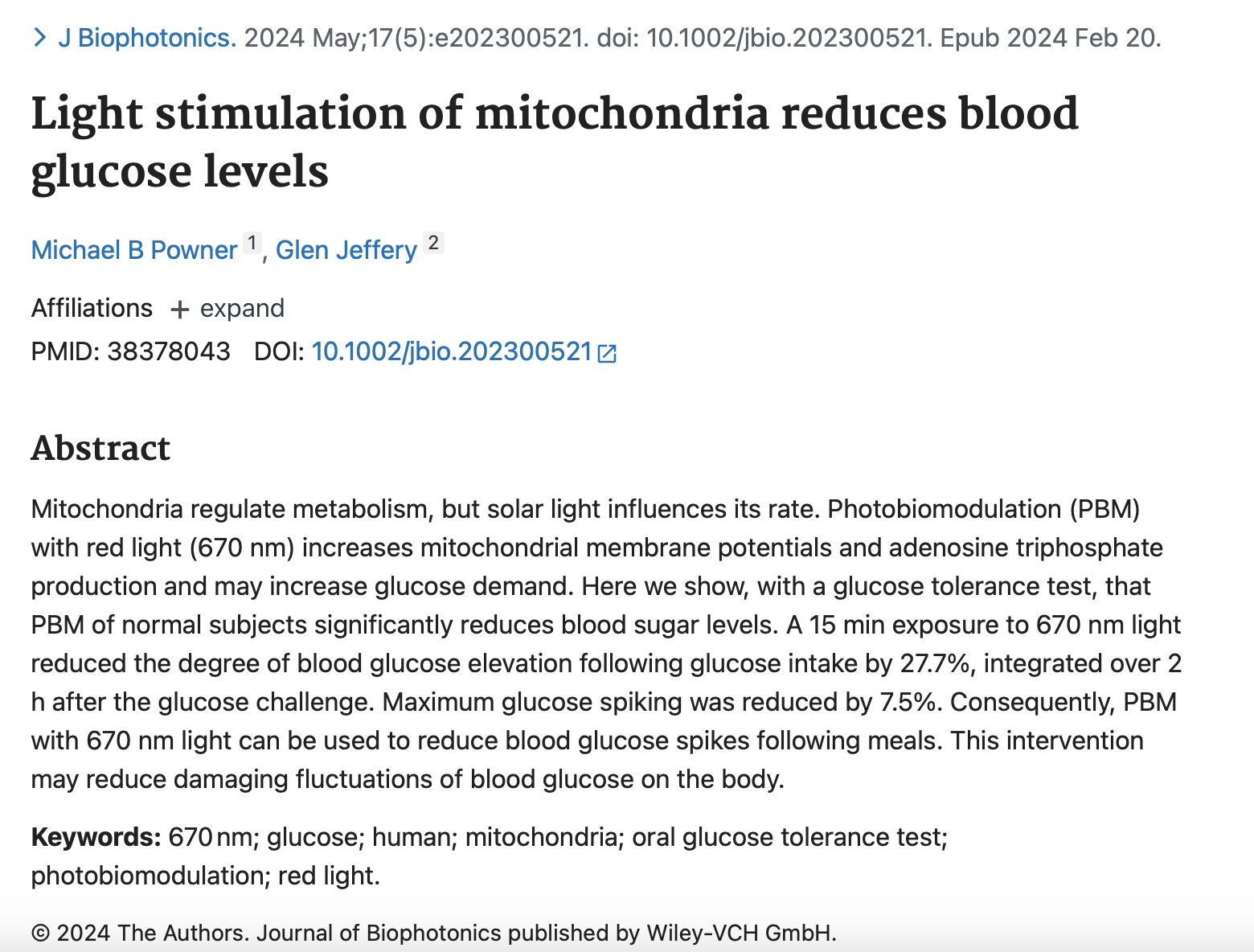
Biophysics (light environment) is more important than biochemistry.
The terrain decided what the substrate could do, before the substrate had a vote.
And here's the piece not to skip past: the same eye that's been reading recipes off a screen all day has been getting repeated, false "it's noon" signals from that screen, and the dark half of this cycle is carrying just as much weight as the light half, whether you've been managing it or not.
The effort was aimed at the only lever anyone ever handed you. There's another one, upstream, that nobody mentioned.
You already have a system: the containers, the Sunday ritual, the tracked macros. The question worth sitting with isn't what to add to it. It's this: on the mornings you're portioning chicken into containers under kitchen light, what would it look like to step outside for the actual sunrise first?
The Pinterest board doesn't need forty-four pins. It needs the yard.
Take-home: More food and more supplements can't fix a body that isn't set up to use them. Light is what sets that up. Getting outside in the first hour of the morning may do more for your metabolism than another change to your macros ever could. It's just a different place to start looking.